
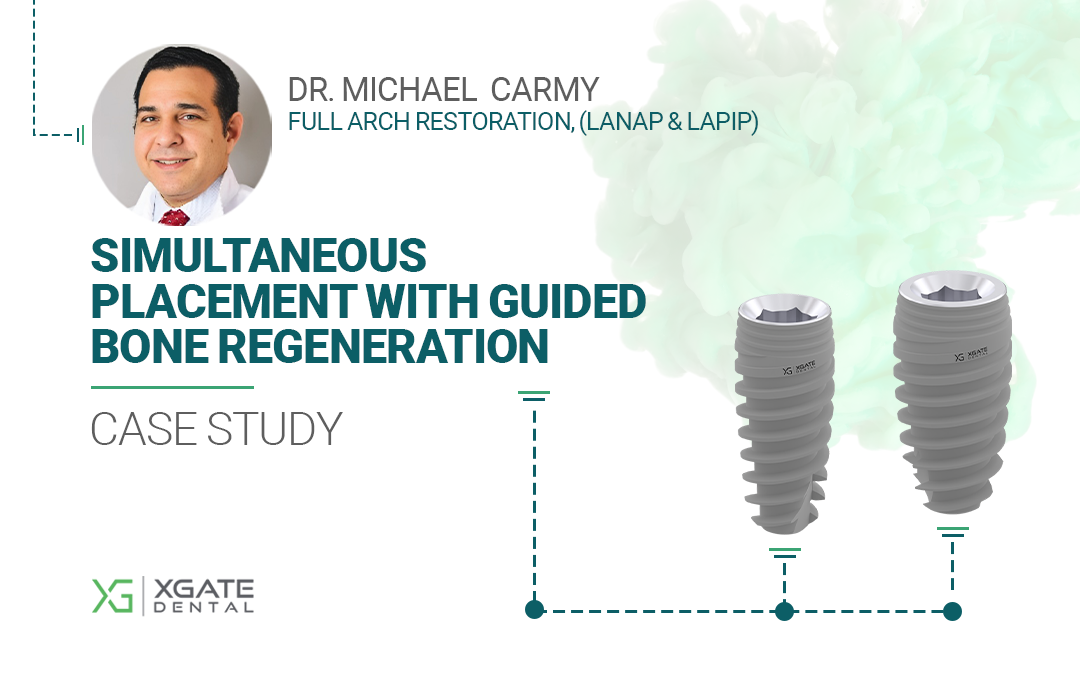
This clinical case highlights a successful bone augmentation procedure. This report details the first stage of treatment: the placement of two implants in the upper right quadrant of the maxilla.
The description of this case was provided by Dr. Michael Carmy from California. Dr. Carmy has over 20 years of experience in dentistry, including more than a decade specializing in Dental Implantology and digital workflows.
First, let’s get acquainted with the doctor:
Dr. Michael Carmy
Main areas of expertise: Full Arch Restoration, advanced laser dentistry (LANAP & LAPIP)
Experience: 20 years
Workplace: Rialto, California, USA
Initial Clinical Situation of the Patient
Missing teeth:
- Posterior right maxilla

- Posterior left mandible
Treatment Procedure
The treatment of the maxilla was complicated by significant bone volume deficiency, necessitating bone grafting to enable implant placement. The image below clearly illustrates the limited available bone and indicates the planned implant positions.
To restore the required bone volume, a sinus lift was performed using a technique pioneered by Dr. Istvan Urban, which is characterized by high predictability and stable results.
In essence, this technique differs from a classic sinus lift in that the bone graft material is secured by a dual-membrane approach.
A resorbable collagen membrane is placed in direct contact with the graft material. This membrane dissolves as the site heals (see image below).
Equally important is ensuring the rigidity of the structure containing the graft material. To achieve this, titanium-reinforced PTFE (Teflon) membrane was placed, as shown in the image below.
The following photo shows what the membrane looks like on a CBCT scan. The reinforcing plate and pins that fix the membrane are clearly visible here.
Let’s look at the treatment procedure in more detail.
First, an incision was made and the soft tissue was reflected.
Despite the bone deficiency, two implants were placed:
- Ø5.0 x 10 mm implant in the molar position
- Ø4.2 x 10 mm implant in the premolar position
Next, a lateral window osteotomy was performed to access the maxillary sinus. The bone graft material was then placed into this space.
The composition of the bone graft material is noteworthy. The graft consisted of a 50/50 composite of autogenous bone and a xenograft. The autogenous bone provides viable osteogenic cells for rapid integration, while the xenograft acts as a scaffold, providing volume and structure for new bone formation. If a defect is filled only with autogenous bone, there is a higher risk of resorption before a sufficient volume of new bone can mature.
The mixture was also enhanced with GEM 21S, a growth-factor enhanced bone graft. As a completely synthetic material, it eliminates the risks associated with allografts.
GEM 21S contains a recombinant human platelet-derived growth factor, which stimulates the migration and proliferation of osteoblasts, cementoblasts, and fibroblasts. The addition of this biomaterial promotes mesenchymal stem cell proliferation, angiogenesis, and early osteoblastic activity.
Furthermore, the patient’s own blood, present in the autogenous bone chips, serves as a natural source of platelets and a binding agent, creating a malleable consistency (“sticky bone”). This consistency is ideal for contouring the graft and ensuring its stability at the recipient site.
The “sticky bone” mixture was then carefully packed into the subantral space, elevating the Schneiderian membrane. This graft volume was then covered with the resorbable collagen membrane, as shown in the picture.
Next, a small amount of graft material was placed over the collagen membrane before the non-resorbable membrane was secured over the entire site.
The membrane was stabilized with pins, which are clearly visible on the CBCT scan.
Following the fixation of the PTFE membrane, the flap was repositioned and sutured. Postoperative radiographs were taken, and the patient was dismissed.
The radiograph confirms the implants are in a prosthetically favorable position.
Note: Two implants were also placed in the posterior left mandible according to a standard two-stage protocol. We will not go into details here.
The healing process was monitored by Dr. Carmy over a period of five months. At the intermediate stage, the patient received healing abutments. As shown in the clinical photo, the soft tissues around the abutments demonstrate adequate density and stability.
After the healing phase was completed, 1 mm V-Type multi-unit abutments were placed, as indicated by their corresponding color coding.
The color coding of XGATE multi-unit abutments (MUA) merits special attention, as each height option is assigned a distinct color. The minimum available height is 0.5 mm—a feature not offered by many manufacturers—despite the fact that clinical situations requiring abutments of minimal height occur relatively frequently.
These abutments were selected for their large 10 mm² support surface area and their ability to correct implant angulation discrepancies of up to 40°. Additionally, their low-profile conical design (0.8 mm height) minimizes the risk of thinning the prosthetic material at the abutment interface—a potential issue with other multi-unit systems.
The following images show the final restoration — a screw-retained bridge supported by V-Type multi-unit abutments from the German company XGATE Dental.
The marginal bone level remains stable, and the soft tissue profile has improved significantly compared to the initial condition. However, the image below shows a less-than-ideal contact between the gingiva and the prosthetic restoration, which may require soft tissue correction using a free gingival graft in the future.
XGATE Dental Products Used in Case Study
This clinical case utilized XGATE X3 Internal Hex implants with V-Type multi-unit abutments for simultaneous implant placement and guided bone regeneration in the posterior maxilla.
Download Resources
Get the complete case study and explore our product catalog
Case Study • PDF • 3.3 MB
📥 Download Case StudyProduct Catalog • Online
🔍 View Product CatalogWe hope you found this clinical case interesting. If you have any questions about the characteristics and delivery of XGATE Dental products, please contact us in any convenient way.
XGATE Dental Group GmbH
Falkensteiner Straße 77, 60322
Frankfurt am Main
Germany
E-mail: [email protected]
350 W Passaic
St Rochelle Park, NJ 07662
United States
Disclaimer: Any medical or scientific information provided in connection with the content presented here makes no claim to completeness and the topicality, accuracy and balance of such information provided is not guaranteed. The information provided by XGATE Dental Group GmbH does not constitute medical advice or recommendation and is in no way a substitute for professional advice from a physician, dentist or other healthcare professional and must not be used as a basis for diagnosis or for selecting, starting, changing or stopping medical treatment.
Physicians, dentists and other healthcare professionals are solely responsible for the individual medical assessment of each case and for their medical decisions, selection and application of diagnostic methods, medical protocols, treatments and products.
XGATE Dental Group GmbH does not accept any liability for any inconvenience or damage resulting from the use of the content and information presented here. Products or treatments shown may not be available in all countries and different information may apply in different countries. For country-specific information please refer to our customer service or a distributor or partner of XGATE Dental Group GmbH in your region.